
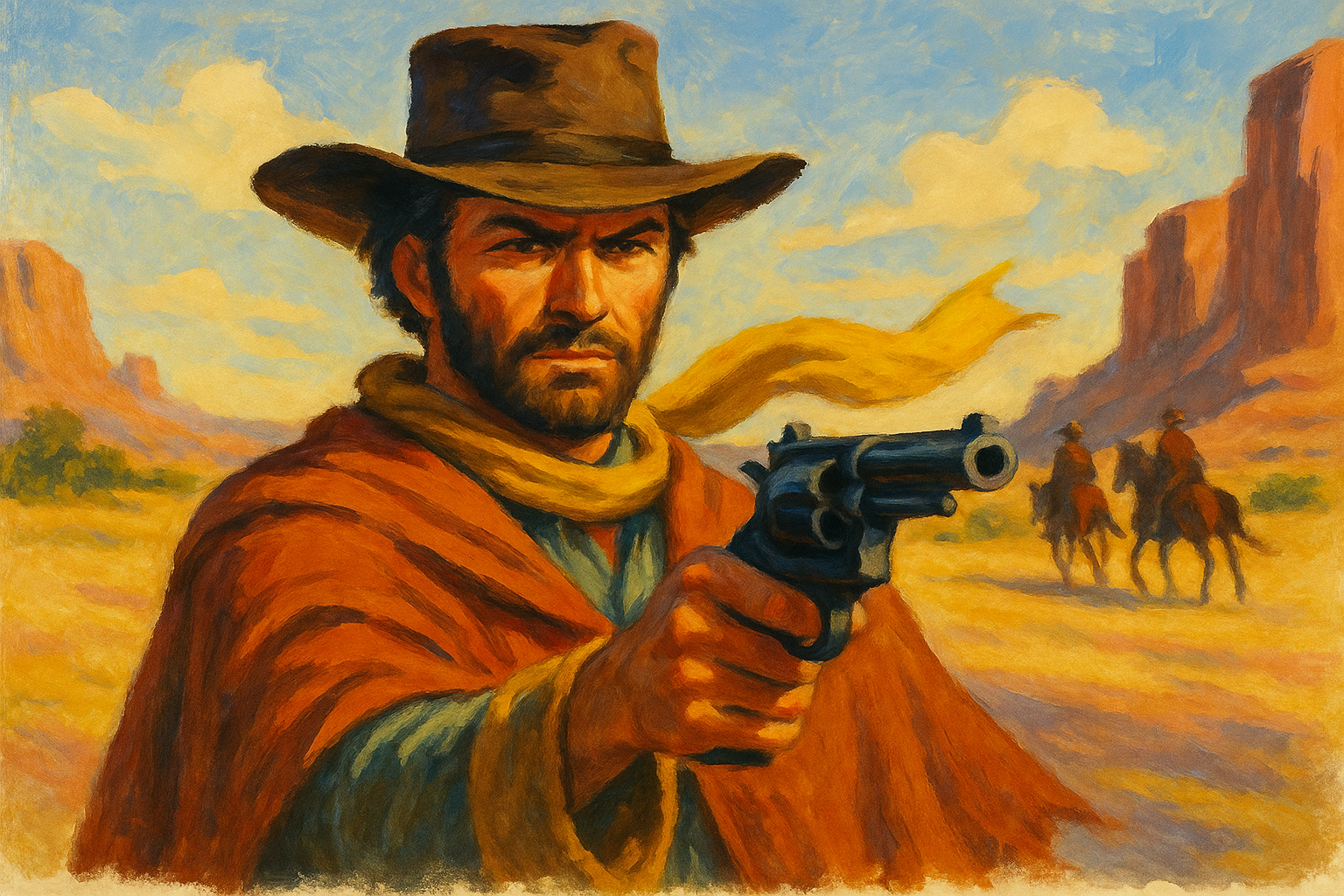
I have heard of the legend that is Clint Eastwood, of course, and I’d be able to pick him out in a line-up any day, but would you believe it? I’d never seen one of his films until I recently made it a goal for myself to watch my first Western film.
My late grandfather was a big fan of the Western genre, and though he tended to favor the softer, more staged John Wayne films to the later Spaghetti Westerns, Pale Rider (1985), a film that hangs between the two, was reputably one of his favorites.
I thought it would be best to watch a traditional Spaghetti Western as my first western film. That subgenre interested me most due to its Italian heritage and its evident impact on the Western genre and filmmaking discipline as a whole. Italians making westerns? Yes, please. But, figuring that a western directed by and starring Eastwood was likely going to show the influence of the Spaghetti Westerns (hereafter to be referred to as SW’s) that made him, I settled on Pale Rider (1985) instead of a true SW.
One question I pondered as the film began was how Eastwood’s interpretation of the genre would differ from that of the traditional SW and early Western. Though shot a bit later into his career (1985) and some twenty years after the advent of the SW into the American culture, I assumed I’d see an homage to the subgenre that gave him his fame.
A significant way SW’s diverged from the Westerns of the first half of the twentieth century was how the men of the wild west were depicted. On his website, movie historian Tim Durks highlights the SW subgenre’s estrangements from the Western genre. Earlier westerns (the likes of John Wayne) depicted men as clean-cut and well-spoken, trimmed and manicured. The lines of good and bad, moral and immoral, were as clearly drawn as a line in the sand, what Hank Webra, a writer for Variety, called the “law-virtue syndrome of the past” (1968). SW’s drew no such clear lines and instead reflected closer realities to the enigmatic souls of men living life out in the wild west, survival on the frontier, and the violence and bloodshed that stained the prospering hopes of gold miners and ingenues of the Manifest Destiny.
Eastwood’s 1985 film does hold true to the general format of a SW. There is a morally ambiguous, mysterious stranger with no name who suddenly appears at just the right time to restore the balance between good and evil, a powerful bad guy with equally mean friends, and a woman who sees the mysterious stranger as being more desirable than her true mate. But, where Pale Rider (1985) sadly diverges from Eastwood’s SW origins (The Good, The Bad, and the Ugly (1966), A Fistful of Dollars (1964)) is in the music, the unwritten element to the SW.
Music is imperative in any film, but arguably even more so in a SW. As I sit here and write this, I can’t remember a single instance when Lennie Neihaus’ score for Pale Rider (1985) moved me or influenced the way I experienced the story. Here’s why.
The scores of SW’s subverted expectations and contrasted with what the audience saw on the screen in a way that salvaged beauty from agony, and excavated deeper meaning with staggering simplicity.
Neihaus, though a good composer in his own right, failed to accomplish the same.
*Interestingly, Eastwood did have the sense to ask Ennio Morricone to score his films, but out of loyalty to Sergio Leone, Morricone declined. He would later regret his decision.
A True Spaghetti Western Gets It Right
Once upon a Time in the West (1968)….Ennio Morricone, you have my heart.
The best part? The music didn’t die with SW’s. Many of us have experienced the influence of SW’s and their scores even if we haven’t seen a SW itself. Take Django, Unchained (2012) for example. The Quentin Tarantino film revisits Sergio Corbucci’s 1966 film, Django, and pays tribute to the SW subgenre in many ways, most notably through music.
Tarantino’s film is unique in that it features several recycled film score pieces from earlier SW films (“The Braying Mule” (1970), “Sister Sara’s Theme” (1970), “Une Momento” (1967) composed by Ennio Morricone, an Italian composer strongly associated with Sergio Leone and the SW subgenre. But Morricone wasn’t the only SW composer Tarantino tipped his hat to. The 2012 film also lauds Django’s (1966) original theme song, “Django”, composed by Luis Bacalov and performed by Rocky Roberts. (Incidentally, one of my favorite songs.) Bacalov, an Argentine-Italian composer was also a well-respected composer for SW film scores early in his career. Along with “Django”, his song “Lo Chiamavano (His Name Is King)” (1971) is included in the 2012 film.
Tarantino’s 2019 film, Once Upon a Time in Hollywood starring Brad Pitt, Margot Robbie, and Leonardo DiCaprio also revitalizes and repurposes the music of SW’s for a new generation. Morricone’s SW scores can also be heard in commercials the likes of Dolce & Gabbana and Modelo.
Music changes everything. A Morricone score could have elevated Pale Rider and adversely, an inferior composer could have utterly squashed Sergio Leones vision for westerns.



Leave a Reply