
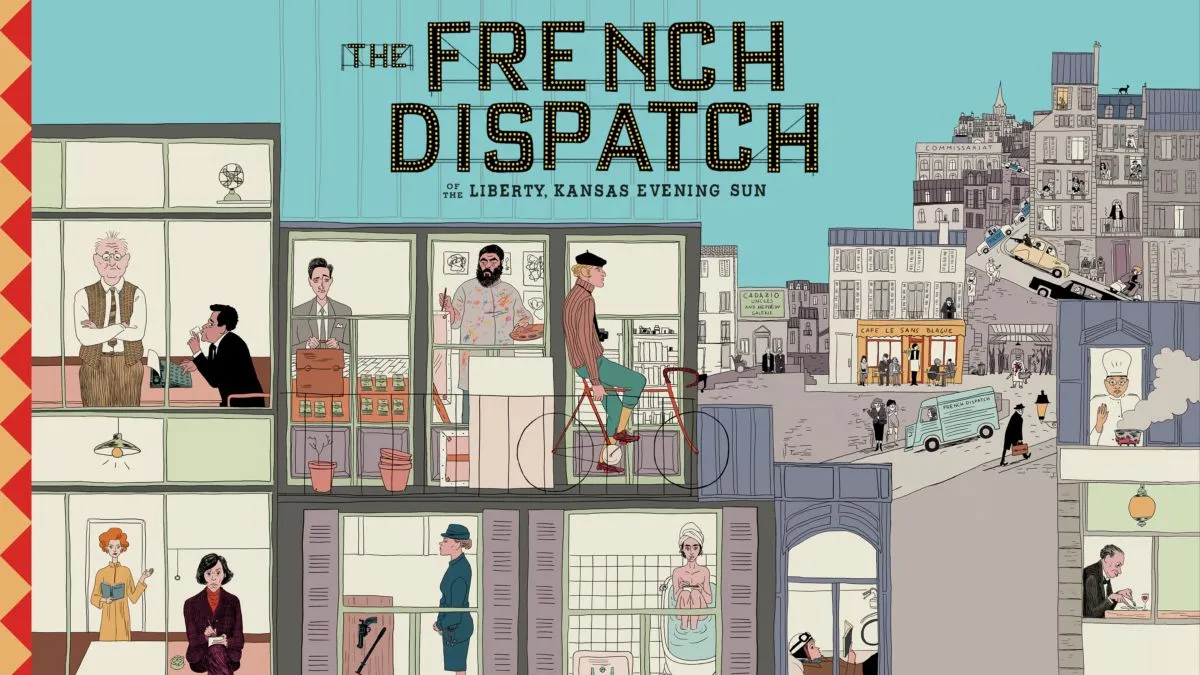
The French Dispatch (2021) was good because it was Wes Anderson, but in the way that the 2022 Spring/Summer Renaissance collection of Dolce & Gabbana is good because its quintessentially Dolce but otherwise confusing and aimless. Like Domenico and Stefano decided to play dress up with three generations worth of clothing. Utter chaos and asynchrony. There’s a point here, I promise.
Story flops
From the first trailer glimpse of The French Dispatch, the cinematography promises to be masterful, the humor dry and quick, and the overarching story engaging. The film delivers on two out of the three. But what the trailer does well to hide is that the story (actually three narratives) is held together by an extremely weak thread. And that the thin thread holding it together will do little to help the reader get from one story segment to the next. It would have been better to watch the film in pieces, to take in each story isolated from the others with a mental reset in between segments. Better yet, the three segments, “The Concrete Masterpiece” awash with A-Listers Benicio del Toro, Adrien Brody, Tilda Swinton, and Lea Seydoux, “Revisions to a Manifesto” with Timothée Chalamet and Frances McDormand (a most unlikely pairing) and “The Private Dining Room of the Police Commissioner” are each well set up to function as separate, quirky short successive films…like how “Hotel Chevalier” precedes The Darjeeling Limited (2007).
The Liberty, Kansas Evening Sun turned The French Dispatch publication as a commonality wasn’t enough to hold the storylines together in one reel, or to earn 108 minutes of my time, sadly. I fought to stay in it because I’ve been highly influenced by Anderson’s work, but walked away feeling duped.
Sure, it was clever that the film reflected the structure of the publication with one travelogue, three features and an obituary, but it wasn’t enough to bind it all together. It wasn’t enough to make me feel any empathy for The French Dispatch’s final issue (which, by the way, was the real underlying motive to the story being told). Nor was the fictional Ennui-sur-Blasé of which we only get a small glimpse through the short travelogue given by the writer Sazerac (Owen Wilson) enough to root the magazines fictional history. And the death of the papers’ editor, Arthur Howitzer (Bill Murray) inspired nothing, his character buried in the multiple narratives.
But visuals triumph
The film was highly celebrated by Richard Brody writing for The New Yorker, but that’s little consolation and a bit fishy, eh? Considering that The French Dispatch (2021) is based on the history of The New Yorker and some of its more illustrious writers and contributors.
And it’s been highly praised for its visual art, but even a great work of static art will reveal a story or supply enough human emotion to create one. And this film felt more like Wes Anderson opened his notebook of ideas and said, “Ah, hell with it. Let’s do it all.”
Let’s take into consideration that the film was birthed out of a highly pressurized pandemic which reorganized priorities and stored up creative expression like a grenade want to go off. And then, BOOM! This might be Anderson’s creative grenade as the 2022 SS Collection is Dolce & Gabbana’s. Unhinged creative expression.
More likely, though, microcosmically, this film can be understood as the art of Moses Rosenthaler.
And the conversations Julian Cadazio (Adrien Brody) and Uncle’s Nick (Bob Balaban) and Joe (Henry Winkler) have over it might well be conversations we have about the film itself. Only sub “modern art” for “American anthology comedy drama”.
***
JULIAN CADAZIO. Modern art. Our specialty, starting now.
UNCLE JOE. I don’t get it.
JULIAN CADZIO. Of course you don’t.
UNCLE JOE. Am I too old?
JULIAN CADAZIO. Of course you are.
UNCLE NICK (referring to the painting). Why is this good?
JULIAN CADAZIO. It isn’t good. Wrong idea.
UNCLE JOE. That’s no answer.
JULIAN CADAZIO. My point. You see the girl in it?
UNCLE NICK. No.
JULIAN CADZIO. Trust me, she’s there.
***
Is this film good? Wrong question to ask. But then what does Anderson want his audience to see here? I’m still trying to figure that out, but I do trust Anderson’s talent and intentions enough that I expect to find bits of his film subtly affecting my perspective of life one day (Maybe this article is proof enough of its impact). In the meantime, the definitive quote of the film gives all the justification for what the film is that Anderson needs to offer:
JULIAN CADAZIO. One way to tell if a modern artist actually knows what he’s doing is to get him to paint you a horse, or a flower, or a sinking battleship or something that’s actually supposed to look like the thing that it’s actually supposed to look like. Can he do it?
Cadazio holds up a rendering of a small sparrow drawn by Rosenthaler in the jail.
JULIAN CADAZIO. The point is, he could paint this beautifully if he wanted, but he thinks this is better.
We’ve seen Anderson draw his sparrow; he knows what he’s doing. We aren’t watching a novice at work, but an auteur with intention.
The French Dispatch (2021) blurs the line beneath visual art and film, and for better or for worse, sets story aside for, perhaps, what the creator thinks is better for now.



Leave a Reply