
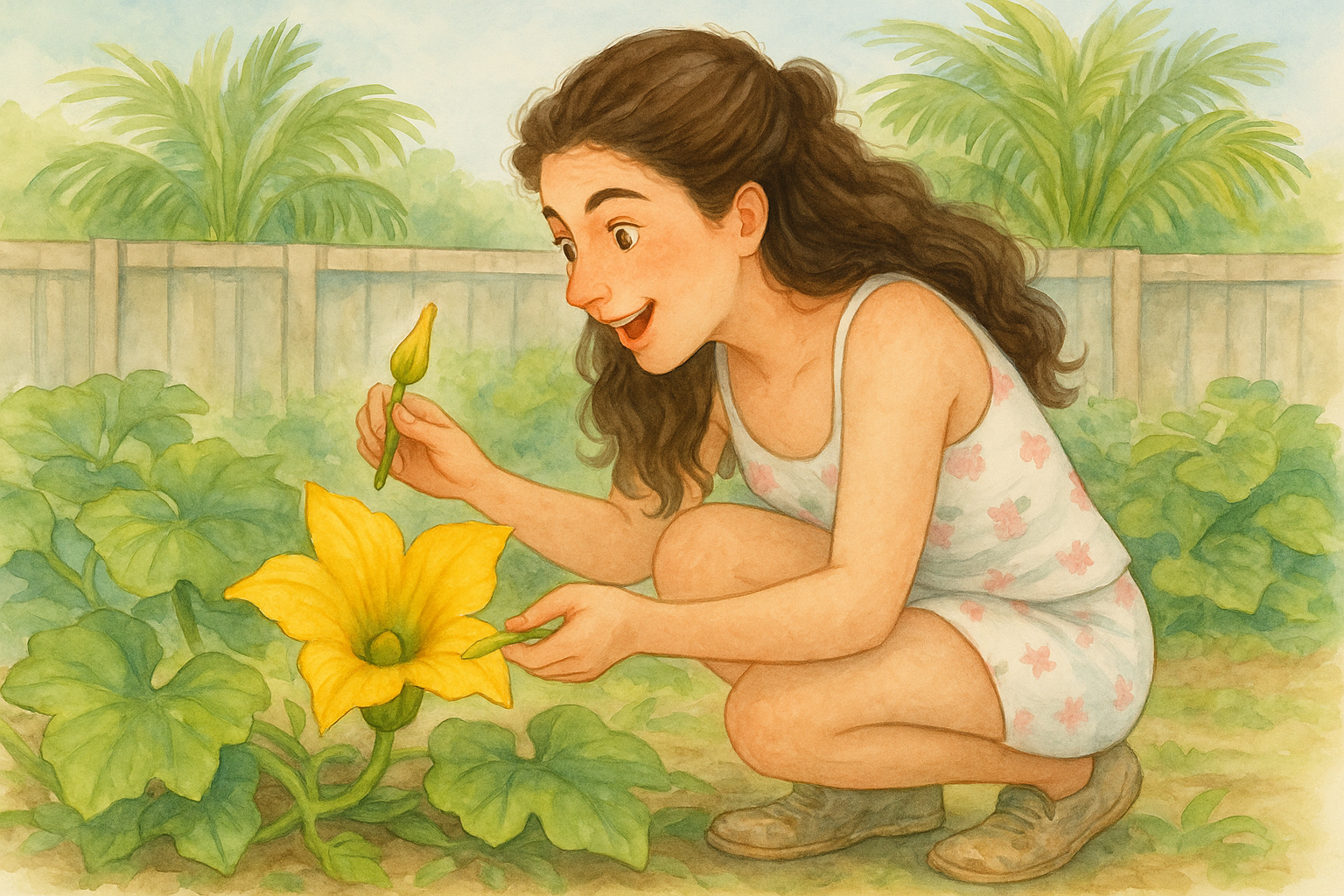
The morning sun spilled across Jenny’s window, and there they were—two brilliant yellow blooms peeking from the overgrown pumpkin sprawl of the Pellegrino Table Garden.
In an instant, she was skidding around the corner of the kitchen and hauling open the back door in her pajamas, gardening shoes half on, she ran to the small patch on the far side of the backyard. She delighted, kneeling down among the leaves, moist dirt from the previous nights rain scraping against her pjs. Two (almost) perfect yellow Seminole pumpkin flowers had surely bloomed. They were almost identical at first glance, both the same vibrant yellow, both with four folds, and both with a deeper center. But there the similarities stopped. One, half hidden beneath several wide leaves the size of a large glove was the male. It had a long thin stem upon which the flower sat and deep inside stood happily erect the stamen. The other, a female flower that had come out of hiding to absorb the morning sun evidently showed its difference. At the base of the flower there sat a plump, round bulb — the unfertilized pumpkin — that gradually slimmed into the stem. Inside the female flower, was the cluster of stigmas which looked like another smaller flower.
She looked around hurriedly. Pumpkin flowers only bloom for one day before closing their petals. If the female flower didn’t get fertilized, the small bulb would die and fall off. It was the pollinators job to fertilize the flowers, but, Jenny looked around the garden in process. The garden was young and the only flowers had been planted on the other side of yard. She would have to self-pollinate.
She cut off the male flower at the stem. Carefully, she peeled the yellow petals away from the stem base, exposing the stamen. She would gently brush the female stigmas with the stamen to transfer the pollen, but something caught her attention.
“Oh no you don’t!” It was a pumpkin worm. A pale green, one inch long and growing fast on its way to maturity, where it would become a moth, the worm had eaten through the side of the petal and squiggled its way down to the stigma, leaving a trail of refuse as it went.
She took her scissors and snipped the worm in half and a green goo squeezed out of it. But it had to be done. The worm would eat the leaf and might burrow into the immature pumpkin, prohibiting its growth. Jenny surveyed the other plants. A trail of refuse was a telltale sign that other caterpillar worms were eating the leaves or wrapping themselves in cocoons to morph into moths. A little to the right of her newly bloomed flowers, she noticed one such sign. On the wide pumpkin leaf, collecting towards the stem, a trail and then small pile of little blackish green droppings, each no larger than a granule. She trailed her finger to the top tip of the leaf and sure enough, a caterpillar was beginning to web itself into the a little crevice it had made by drawing two small edges of the leaf together. The caterpillar was thick but just starting this process. She clipped it in half. It had to be done. If allowed to morph, emerging moth would return to lay eggs and a new batch of caterpillars would eat and destroy the leaves of the plant which would limit their ability to take in energy from the sun, which would prohibit plant growth. Nearby, another fold in a leaf caught her eye. This one was tightly folded and a little lift at the fold revealed something brown, unlike the light green caterpillars. This was a nearly morphed moth. She clipped it in half. It had to be done.
Directing her attention back to the open female flower, she picked up the male flower, its stamen still exposed and proceeded with her original task. Gently brushing it against the stigmas she hoped to transfer the pollen and that she would soon see the small, hard bulb at the base of the flower grow into a sweet little pumpkin. And fingers crossed, soon, others would join this first one. The vines trailed for six feet in all ways, spilling out the planter box from which two seeds were first planted in early June. The two main stems were thick, green and a little bit prickly. From those two stems came the main vines and from the main vines branched out several more vines so that in total there were seven or eight vines from just two seeds. Each vine crawled along the ground, grabbing hold of whatever it could get its tendrils to wrap around. And along each vine, sets of leaves revealed the male and female buds in various stages of development. Some looked ready to bloom any day; they stood tall on the vine and had a deep green color at their base and then lightened to the tip. That was the flower of the verge of blooming. One day it was closed up and pale green, and the next day, it was the brightest saturated yellow and wide open for the world to see. But some buds were still very young on the tips of the ever growing vine. Tiny and pale green, the males had a crown of petals. The females looked like miniatures of their mature counterparts, like something one might make for a doll house.
Jenny loved to watch and roam the small yard, inspecting the readiness of the plants, even if it did mean snipping unwanted caterpillars. She would have to watch the female flower she attempted to pollinate closely now, being sure to keep the bugs away from ruining it before it has a chance to set.
A mistake early on in the planting also presented another challenge for her. Once the pumpkin started to grow, they would be sitting on a wet ground of weeds. This would leave them susceptible to bugs and rot, especially if a heavy rain came which was likely to happen in a Florida summer. She would have to be clever to protect the new pumpkin if it continued to grow. But that was a problem for another day and she suddenly became aware that she was still in her pajamas for goodness sake. It was time to go inside and start the day.
Want to Be Sure Your Seminole Pumpkin Grows?

Seminole pumpkins are a specific variety of pumpkin grown in warmer climates. They were named after the Seminole tribe living in Florida, and were a staple food source often growing along side of corn and beans. You read more of their history and how to grow from seed to fruit here. They have incredible storage potential, storing as long as 14 months and sweeter than the average pumpkins, often being compared to butternut squash.
In an ideal world, pumpkins are pollinated by pollinators in your garden. It’s good to plant flowers and have other vegetables potentially growing that could attract pollinators. But to ensure pollination, some measures may need to be taken. It’s also a good idea to get up close and personal with the flowers to check for pests like the caterpillar.
1. Spot the Right Flowers
- Male flowers have long, thin stems and a pollen-covered stamen inside.
- Female flowers have a small bulb (baby pumpkin) at the base and a cluster of stigmas inside.
2. Act Fast
- Pumpkin flowers open for only one morning. If the female isn’t pollinated by mid-day, the bulb will wither and fall off.
3. How to Hand-Pollinate
- Gently cut or pluck the male flower from its stem.
- Peel back its petals to expose the stamen.
- Brush the stamen directly onto the stigmas inside the female flower, making sure pollen makes contact.
- Repeat with another male if available to increase the chance of success.
4. Watch for Pests Daily
- Look for caterpillar droppings (tiny dark pellets) and folded leaves — both are signs of leaf worms or moth larvae.
- Inspect the undersides of leaves and flower bases.
- Remove pests by hand or snip them off with scissors before they damage flowers or leaves.
5. Stop the Moth Cycle
- Caterpillars turn into moths that lay more eggs. Removing them early prevents multiple generations of pests in one season.
6. Protect Growing Pumpkins
- Once a pumpkin sets, place it on a board, straw, or mulch to keep it off wet soil and deter pests.
7. Maintain Healthy Vines
- Water deeply 1–2 times per week, avoiding wetting the leaves. Healthy vines recover more quickly from minor pest damage.
Authors Note: Thank you for reading this story and we hope you enjoyed it. Feel free to hold down those little clapping hands till they hit 50 and leave your thoughts or links to stories you’ve written or think might be of interest. If you’d like to see more story-driven writing, check out the similar posts below.




Leave a Reply