
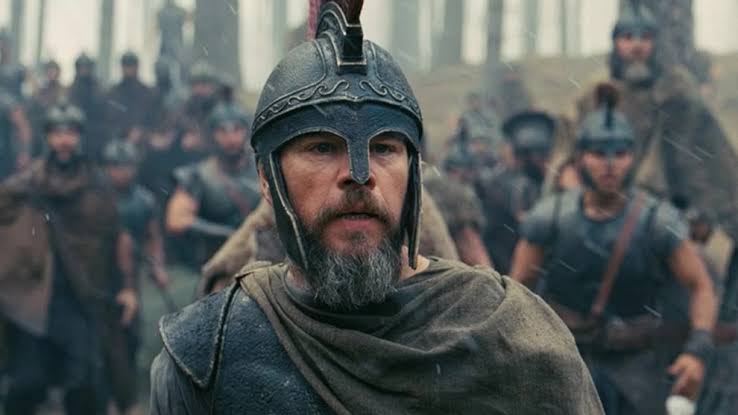
It begins and ends with the hero, Odysseus, who, on screen, is a shadow of the man in Homer’s Odyssey.
An interview in which Christopher Nolan sat with political philosophy lecturer & doctoral student Zhong Shu in Beijing, China, helps unravel the mystery of Nolan’s departure from the source material. The interviewer notes the film’s stark contrast with the epic poem, observing how Nolan first does not celebrate the Trojan War and second frames Odysseus’ journey home as a journey of atonement for breaking Zeus’ law. Rather than celebrating his success in the Trojan War, Odysseus is racked with a guilty conscience. The specter of Athena haunts him as a Trojan victim.
Zhong Shu accurately points out that we live in a culture and time that demands apology for greatness and wonders aloud if that’s necessary in film. Yes, Nolan affirms, filmmakers do have to apologize for greatness in their characters. Otherwise, he claims, the audience will reject them.
Um. Excuse me?
I can get on board with a flawed character who is also great. I can get on board with a character who is great and also apologizes for his flaws. But apologizing for greatness as a storyteller is a gross negligence of responsibility and of all that is good, beautiful, and worthy about humanity. Such “storytellers” have no right to be storytellers. Good storytelling, and good characters, should challenge humanity. The greatness, and alternative depravity, in characters convict us, move us, and teach us. Nolan seems more concerned with making people feel “good” and unthreatened.
All of this, of course, would explain Odysseus’ posture throughout Nolan’s adaptation of The Odyssey. He walks through all the trials, meets all the monsters and the tricksters along the way, just as in the epic poem, with mere shreds of his hubris and might at play, but he is an apologetic, flat, and melancholic, a washed-up warrior. Is he apologetic for his pride? Oh, silly us to think so! No, Odysseus is apologetic for his greatness. His success, his leadership, his very manhood.
Let’s be clear. The plot does not make The Odyssey such an enduring story. Rather, it is the characterization and how that characterization impacts, or is impacted, by the plot. Simply put, there is no hero’s journey without the hero. Adaptations and inspired versions of the basic Odyssey story have been written, like O Brother, Where Art Thou? (2000), but the reason other versions work is that the arc themes and the characterization remain true to Homer’s Odyssey. The same is true of adaptations of Shakespeare’s plays. She’s the Man (2006) retells Twelfth Night. It does not remotely resemble the original play in time or place, but its tropes and characters remain true to the original. 10 Things I Hate About You (1999) is set in a 90s high school, but is another retelling of a Shakespeare play, The Taming of the Shrew. And there are others. The point is, an adaptation can radically change the setting, plot details, gender, period, etc., and still preserve the underlying character dynamics and themes that made the original meaningful.
So yes, Nolan’s Odyssey had all the basic plot points and impressive visualization of Homer’s Odyssey. Still, instead of letting Odysseus’ journey change him and teach us something universally true about humanity, Nolan took the opportunity to moralize.
His take: The Trojan War was wrong. The Trojan horse stunt was mean and sneaky. The men fighting were misogynistic and barbaric towards women. Odysseus’ pride, nearly gone. War, bad; manliness, bad. And in doing so, it completely changed the very mechanisms that set up Odysseus as a lesson for all.
I am not an expert on The Odyssey, and though I know the story start to finish from having taught an abridged version of it for my 9th grade English class during my teaching days and studying bits and pieces through the years of my own education, I have never read a complete translation cover to cover, so take my perspective with the grain of salt but in my video review, I talked a bit about the feminist lens through which, I believe, Nolan told the story. Now, I believe it’s more fundamental than that. Nolan has retained the plot and spectacle of The Odyssey while fundamentally altering Odysseus’s character—and therefore undermining what makes the story endure. In doing so, he expresses a contemporary ideology supremely disadvantageous to a functioning society.
He managed to reinvent the classic hero as a lifeless, dull, apologetic, one-dimensional dud. Just because you dress a man in armor, tell the world he is Odysseus, and put him on an impressive set doesn’t mean he’ll have the same character impact as the thousands-year-old story. The classic hero Odysseus is a fantastic, crafty, deeply prideful, and weak-fleshed warrior. He is exceptional and yet deeply flawed. And the journey he takes to reach home transforms him. Nolan’s Odysseus is flaccid, lifeless, dull, disproportionately apologetic, and one-dimensional.
One of the most frustrating ways Nolan diverged from the classic was with the much-studied theme of “nostos”, or homecoming. The epic poem is structured around Odysseus’ desire to return home to Ithaca after the Trojan War. It’s meant to be an easy, long-awaited journey. But instead it takes him 10 years, on top of the decade he’d already spent fighting in the Trojan War. Along the way, Odysseus is thwarted by his own pride, his passions, his men, his folly, his desire for comfort, and the gods’ oscillating tempers. Still, he desires to return home. He is tempted into comfort on Circe’s island, but still desires to go home. While detained on Calypso’s island for 7 years, he longs to return home, weeping for his wife. His desire to go home, despite these obstacles, is part of what makes this story so universal. He wants to go home, reunite with his wife and son, serve Ithaca as king, and do right by the gods, but he keeps getting in his own way or being thwarted. It’s a similar frustration Paul writes about in Romans when he writes, “I do not understand what I do. For what I want to do I do not do, but what I hate I do. ” (Romans 7:15-16). This tension is part of what makes Odysseus so recognizably human: he knows what he wants, yet his own appetites, pride, and weaknesses repeatedly work against it.
Yet, in Nolan’s Odyssey, he plays around with the idea that maybe Odysseus doesn’t really want to go home. It’s a real matzo ball of an idea introduced when Odysseus and his men sail past the Sirens. Homer’s Odysseus absolutely wants to go home, but the film tells us outright that Nolan’s Odysseus does not.
“It told you what you want most is what you most can’t have and what you most can’t have is what you already had and lost. It was the song of all the promises I failed to keep. And it told me I don’t really want to go home.” (Nolan 119-120)
Of course, we could interpret the Song of the Sirens as an intrusive thought. Perhaps, in Nolan’s interpretation, the Sirens plant the idea in Odysseus’ mind that he doesn’t really want to go home so he will jump from the ship and swim to their island. That would be fine, except, very little about Matt Damon’s portrayal of Odysseus would justify that interpretation. He doesn’t have the tenacity of a man who wants to get home. His journey feels so casual and causal rather than intentional and forward-thinking that I have no choice but to agree with the film version of Odysseus. I don’t believe he really wants to go home. There’s also the issue of Odysseus’ desire to even hear the Song of the Sirens.
In the original text, Circe advises Odysseus about the Sirens’ song in Book 12. Normally, I would not include such a long passage, but it’s important to grasp the tone of the source material”
“First you will raise the island of the Sirens, those creatures who spellbind any man alive, whoever comes their way. Whoever draws too close, off guard, and catches the Sirens’ voices in the air— no sailing home for him, no wife rising to meet him, no happy children beaming up at their father’s face. The high, thrilling song of the Sirens will transfix him, lolling there in their meadow, round them heaps of corpses, rotting away, rags of skin shriveling on their bones … Race straight past that coast! Soften some beeswax and stop your shipmates’ ears so none can hear, none of the crew, but if you are bent on hearing, have them tie you hand and foot in the swift ship, erect at the mast-block, lashed by ropes to the mast so you can hear the Sirens’ song to your heart’s content. But if you plead, commanding your men to set you free, then they must lash you faster, rope on rope.”
Odysseus, in turn, gives a big thumbs up because he fully believes he will overcome the song. He’s Odysseus, after all. He can’t be beaten. And Books 1-11 provide ample evidence that Odysseus is so hubristic that he believes he is worthy of and strong enough to resist the Song of the Sirens.
“So I informed my shipmates point by point, all the while our trim ship was speeding toward the Sirens’ island, driven on by the brisk wind. But then—the wind fell in an instant, all glazed to a dead calm … a mysterious power hushed the heaving swells. The oarsmen leapt to their feet, struck the sail, stowed it deep in the hold and sat to the oarlocks, thrashing with polished oars, frothing the water white. Now with a sharp sword I sliced an ample wheel of beeswax down into pieces, kneaded them in my two strong hands and the wax soon grew soft, worked by my strength and Helios’ burning rays, the sun at high noon, and I stopped the ears of my comrades one by one. They bound me hand and foot in the tight ship— erect at the mast-block, lashed by ropes to the mast— and rowed and churned the whitecaps stroke on stroke. We were just offshore as far as a man’s shout can carry, scudding close, when the Sirens sensed at once a ship was racing past and burst into their high, thrilling song:”
In the film, however, when the men start putting beeswax into their ears to protect themselves against the Sirens, Odysseus refuses and states: “I want to hear it.” Technically, that’s true to the epic poem. But delivery and context is everything. For that simple line to carry the weight of Odysseus’ pride and sense of grandeur—that he can beat the Sirens— the film needed stronger characterization of his pride and sense of greatness up to that point. But because Nolan toned down Odysseus’ pride significantly and created a much more subdued, shame-filled version of the man forced into a posture of shame, Odysseus’ decision to listen to the Sirens in the film feels more like stupid, boyish curiosity than the self-aggrandizement of a man.
Then, the actual Sirens’ song in the epic poem could not have been further from the film’s interpretation.
‘Come closer, famous Odysseus—Achaea’s pride and glory— moor your ship on our coast so you can hear our song! Never has any sailor passed our shores in his black craft until he has heard the honeyed voices pouring from our lips, and once he hears to his heart’s content sails on, a wiser man. We know all the pains that Achaeans and Trojans once endured on the spreading plain of Troy when the gods willed it so— all that comes to pass on the fertile earth, we know it all!’
Most notably, the Sirens do not sing intrusive thoughts, torturing Odysseus with his faults and failed promises or luring him with the idea that he doesn’t actually want to go home, as they do in the film. Rather, the Sirens appeal to his pride.
In another strong diversion from the source material, Nolan transforms the Odysseus/Circe encounter from a contest between two powerful figures governed by divine authority into a therapeutic encounter in which male kindness disarms female trauma.
The film frames Circe as an embittered victim of men. She turns Odysseus’ men into pigs (in an incredibly gross and engrossing scene of clever practical effects) as in the epic poem. When Odysseus visits her home to find his men, Circe offers him food, which he refuses, suspecting it caused his men’s disappearance. What unfolds is a strange dialogue in which Odysseus tries to calm Circe, make her feel safe, and, it seems, emotionally disarm her. He — gently — accuses her of turning his men into pigs and she spits back, looking ragged and witchy:
“I didn’t turn your men into anything! This is who they are. Look at them— base. Disgusting, primal urges you value in battle…they’ve raped and pillaged across the world for you…”
Circe acknowledges that Odysseus may be different from them when she says, “you don’t seem that deluded [as the other men]” but then appeals to him in a pitiful way that completely subverts her attempts to be the strong, independent woman she wants Odysseus and the pig-men to think she is, “you thought they’d respect me in my own home?”
Odysseus asks her: “Did they hurt you?”
And she responds: “They would’ve.”
She is jumpy and defensive for most of their encounter, a woman embittered by presumed and imagined abuses for which she blames Odysseus’ men. In response, Odysseus entreats Circe to restore his men. “They just want to go home”, he says, his voice soft.
In Homer’s Odyssey, Circe matches with Odysseus. She doesn’t make herself into a victim. She meets him, initially, as his equal. Whether or not she holds those embittered thoughts about men so plainly exposed in the film, we don’t know. It may be, but the text offers little evidence for it.
We also don’t see Odysseus treat Circe like a hurt, wounded individual in the text. He eats her food, knowing the protection of the gods is on his side.
“When I got through the charmed grove, and was near the great house of the enchantress Circe, I met Hermes with his golden wand, disguised as a young man in the heyday of his youth and beauty with the down just coming upon his face. He came up to me and took my hand within his own, saying, ‘My poor unhappy man, whither are you going over this mountain top, alone and without knowing the way? Your men are shut up in Circe’s pigsties, like so many wild boars in their lairs. You surely do not fancy that you can set them free? I can tell you that you will never get back and will have to stay there with the rest of them. But never mind, I will protect you and get you out of your difficulty. Take this herb, which is one of great virtue, and keep it about you when you go to Circe’s house, it will be a talisman to you against every kind of mischief.
“‘And I will tell you of all the wicked witchcraft that Circe will try to practice upon you. She will mix a potion for you to drink, and she will drug the meal with which she makes it, but she will not be able to charm you, for the virtue of the herb that I shall give you will prevent her spells from working. I will tell you all about it. When Circe strikes you with her wand, draw your sword and spring upon her as though you were going to kill her. She will then be frightened, and will desire you to go to bed with her; on this you must not directly refuse her, for you want her to set your companions free, and to take good care also of yourself, but you must make her swear solemnly by all the blessed gods that she will plot no further mischief against you, or else when she has got you naked she will unman you and make you fit for nothing.’”
Odysseus follows the instructions Hermes gives him. And when he charges Circe with intent to harm her, she is frightened, not by Odysseus’ manliness but by his ability to escape the poisonous effects of her food. She falls to her knees and asks Odysseus who he is. But she already knows, and in a short monologue applies herself to something greater than herself: the will of the gods.
“Who and whence are you? From what place and people have you come? How can it be that my drugs have no power to charm you? Never yet was any man able to stand so much as a taste of the herb I gave you; you must be spell-proof; surely you can be none other than the bold hero Odysseus, who Hermes always said would come here some day with his ship while on his way home from Troy; so be it then; sheathe your sword and let us go to bed, that we may make friends and learn to trust each other.”
She acknowledges Odysseus’ favor with the gods, remembering a foretelling of Odysseus’ arrival by the god Hermes, and lets the men and Odysseus go free.
In Homer’s Odyssey, neither Odysseus nor Circe become emotionally neutered in their exchange; both remain strong, powerful figures (one prideful and flawed and one kind of evil) who are equally put in their place by the will of the gods. Circe responds to Odysseus with regrettable reverence, acknowledging and fearing the gods, but avoids being victimized. In the film, her fearful and embittered response to Odysseus isn’t in recognition of who he is (because Nolan chose to eighty-six the gods and therefore Hermes never plays his key role, and Odysseus never eats the meat and is therefore unable to show Circe he has the favor of the gods) but rather due to a male-sized chip on her shoulder.
There is also a broader cultural implication here that I find difficult to ignore. By turning Circe from a powerful adversary into an embittered victim who is ultimately disarmed by Odysseus’ kindness, Nolan risks reducing the relationship to a familiar narrative: a wounded woman whose bitterness is softened and ultimately resolved by the kindness of a good man. Kindness is not, of course, a bad plot device. But in this case, the change seems to reinforce a rather thin cultural commentary in which women are primarily victims of men, men are primarily defined by their capacity for violence, and the solution to the conflict between them is for men to be kind lest women become bitter, isolated, vengeful witches, subjugated by the hatred they feel. I believe this is meant to be a feminist take, but discerning feminists will look more closely and see that this intentional rewrite does not “empower” women.
Whatever one makes of the cultural implications, the literary consequence is clearer: the re-characterization of Circe—and of Odysseus—undermines the powerful confrontation between two extraordinary and didactic classical figures.
As a final thought on Nolan’s divergence from the classical Odysseus, look no further than the director himself. His film was never meant to be about the transformation that classically occurs throughout Odysseus’ hero’s journey. It was about making an engaging movie that would satisfy and entertain an increasingly offensive audience. Zhong Shu, I think, wrongly notes that Nolan’s film centers on the pride of Odysseus. But her question is still valid. Should Odysseus repent of his pride? Nolan’s response is crystal clear.
“I mean, I suppose the question could be asked: what difference would it make if he repented, you know? I mean, that’s the interesting thing about these philosophical approaches is that his repentance would be purely internal. It would purely be for his own spiritual self. It wouldn’t necessarily affect anything outside it because the damage is done. Xenia is broken, maybe for all time. I mean, that’s the interesting thing. I think you know that is the thing about hubris. It’s tragic because it’s irreversible, essentially, and that’s where Christian theology looks at it in a different way. But in a practical sense, [repentance] doesn’t necessarily change what’s happened and therefore, in storytelling terms, isn’t necessarily relevant. You know, that’s when I say we bring our understanding to it. So we feel that there’s catharsis because there’s confession, because there’s honesty and intimacy between Odysseus and Penelope. And that was very important to me, and I’m very invested in that emotionally. But if it has no practical effect and the collapse is coming anyway, the catastrophe is coming, you know, what difference does it make if he repents? You know, that’s the interesting thing. Are we concerned with his spiritual well-being or are we concerned with the world that he lives in and the world that, in some sense, he feels he’s damaged?”
There’s something unnerving about Nolan’s understanding of and approach to storytelling here. Repentance, he states, is useless to the plot of a story, because the damage is already done. But repentance as a plot device in literature and film has long been a staple. Take the classic A Christmas Carol by Charles Dickens. The damage is done for Scrooge. He wronged many people and has to deal with the fact that business partners will spend eternity in chains for the deeds in which Scrooge was complicit. Despite this, Scrooge repents, experiences transformative growth, and is able to live out the rest of his days in relative peace and goodness. Practically, Scrooge’s reckoning and repentance move the story forward. (“Tiny Tim, who did not die!”)Whether he says it out loud or not, it affects change in him and therefore changes how Scrooge interacts with the other characters and the plot.
There’s also the fact that Nolan seems to care little about the personal transformative journeys of his characters (which would explain why every character is so flat). He is more concerned with “the world [Odysseus] lives in” and the ways in which Odysseus damaged it (and the message Nolan wants to send you about it). Quite a dismal take. It’s prioritizing the collective over the individual. But that ignores the very crucial reality that it is the individuals who make up the collective.
Nolan is also more concerned with the optics, what we can see. That makes sense. He’s a film director, but all good films move their audience beyond seeing to feeling – be that admiration, inspiration, disgust, conviction, joy, etc. – and reflection, and that’s largely done through the mechanisms of character.
Not only has Nolan diminished the classical Odysseus by forcing him to apologize for his greatness, he has also prohibited Odysseus from repenting of his pride. Why is apologizing and seeking atonement for his participation in the war allowed, but repenting for pride is not? From where I sat, Odysseus’ shame did nothing for the plot whatsoever; it had no impact, but to suck the soul out of an epic.
Would it really be so useless for Odysseus to repent and move forward as a better, transformed man? If Nolan was going to retell The Odyssey in a fresh and interesting way, repentance would have been a great idea. It would have provided an opportunity for the storytellers and audience to think differently about an ancient story in an enriching way, to envision how repentance might actually transform the plot and the man at its center.
I wonder how this film will be received in 30, 40, or 50 years. Will it be remembered for the storytelling and characterization, or for the impressive visualization, cinematography and practical effects? Only time will tell.
Sources:
The Complete Screenplay of The Odyssey (2026). Written by Christopher Nolan.
All quotes from Homer’s The Odyssey come from Samuel Butler’s translation.
***
Authors Note: Thank you for reading this story and we hope you enjoyed it. Feel free to hold down those little clapping hands till they hit 50 and leave your thoughts or links to stories you’ve written or think might be of interest. If you’d like to see more story-driven writing, check out the similar posts below.



Leave a Reply